
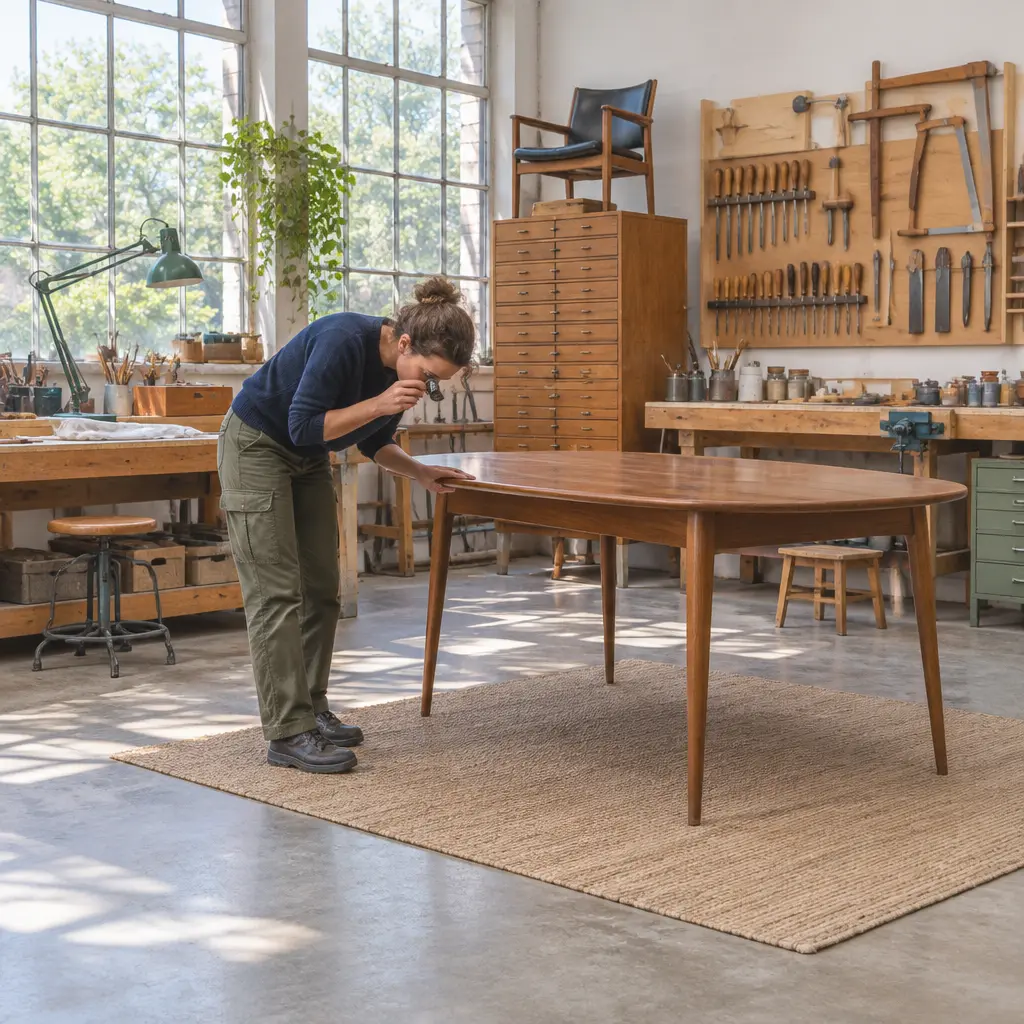
Mid-century furniture described as “solid wood” may contain solid boards, decorative veneer over a less costly core, or a mixture of both. Veneer is genuine wood, but its thinness means that identifying it—and checking whether it remains sound—matters when evaluating a furniture claim, planning repairs, or assessing durability. The USDA Forest Products Laboratory’s Wood Handbook explains how wood structure and processing affect material behavior, while conservation guidance from the Canadian Conservation Institute emphasizes examining construction and condition rather than relying on surface appearance alone. This guide distinguishes veneer from solid wood, outlines practical inspection methods, explains the limits of common tests, and shows how to document findings without overstating what they prove.
Veneer construction and solid-wood claims
Wood veneer is a thin sheet of wood bonded to a supporting material. It is not a printed imitation: the visible surface is real wood, but the panel as a whole is not solid wood if its core is plywood, particleboard, fiberboard, or another substrate. Solid wood, by contrast, is made from wood pieces through the relevant thickness, although a finished item can still combine solid components with veneered panels.
The Federal Trade Commission’s Guides for the Furniture Industry address how furniture descriptions should avoid misleading buyers about materials and construction. In practical terms, a seller’s phrase such as “solid walnut” should be checked against the actual components and the exact scope of the claim: a table may have solid legs and rails but a veneered top. “Walnut veneer” can accurately describe a real walnut surface over a different core.
Mid-century furniture commonly used veneer to achieve broad, visually continuous surfaces and make efficient use of high-quality face wood. A veneer panel may be stable and long-lasting when well made and kept in suitable conditions; veneer alone does not establish that a piece is cheap, poorly built, or counterfeit. The key questions are what the surface and core are made of, how they were joined, and whether the bond and wood remain sound.
Veneer, plywood, and other panel types
Plywood is an engineered panel made by bonding thin wood layers, usually with adjacent grain directions arranged crosswise. A plywood panel may itself have a decorative face veneer, so “plywood” and “veneer” are not mutually exclusive descriptions: one names a panel construction, while the other can name its surface layer. Particleboard and fiberboard use wood particles or fibers rather than continuous wood plies as their core.
The USDA Forest Products Laboratory’s Wood Handbook describes wood products and their physical properties, including the way engineered panels differ from solid lumber. For a furniture inspection, identifying a core at an exposed edge can therefore be more informative than judging the face alone. A visible edge may reveal stacked plies, compressed particles, fibers, or a solid board, though trim and edge banding can conceal the construction.
What “solid wood” can—and cannot—mean
“Solid wood” is a construction description, not a guarantee that every part of an object is one uninterrupted board or that the item is made from a single species. Furniture may use joined boards, solid edging, veneer on selected panels, and non-wood hardware. A careful assessment should therefore identify each major component rather than assign one material label to the whole piece based on a single surface.
When claims matter—for example, in a sale, insurance record, or restoration estimate—record the wording of the claim separately from the inspection finding. “The tabletop appears to have a wood veneer over a layered core” is more defensible than “the entire table is fake wood,” particularly when some components have not been examined.
Inspection methods for veneer integrity
Veneer integrity is the condition of the thin wood layer and its bond to the substrate. An intact surface is generally attached, level, and free of significant cracks, losses, or raised areas. A sound-looking face does not prove that every hidden section is bonded, so inspection combines visual observation with cautious, non-destructive checks.
The Canadian Conservation Institute’s preventive-conservation guidance stresses that materials respond to environmental conditions and that examination should account for an object’s construction and history. For furniture, humidity changes can contribute to wood movement, while moisture, heat, impact, or failing adhesive can contribute to veneer distortion or separation. No single quick test reliably identifies every veneer type or proves the full condition of a panel.
Visual signs of veneer and damage
Look first at exposed edges, corners, undersides, drawer openings, and existing chips. Veneer may appear as a thin face layer with a distinct boundary, while a chipped or unfinished area may expose a different-looking core. Matching wood grain across a wide panel can also be a clue, but it is not conclusive: solid boards can be arranged for a similar appearance, and veneer can be carefully edge-matched.
Common integrity concerns include lifting at edges, bubbles or blisters, open seams, cracks, missing veneer, and dark staining that may indicate moisture exposure. Record the location, approximate size, and whether the area moves or changes under ordinary handling. Avoid scraping, prying, or removing finish to investigate: these actions can cause irreversible loss and may destroy evidence of original construction.
Tapping and gentle tactile examination
A light tap with a fingertip or a soft, non-marking tool may reveal a hollow or altered sound over a detached area compared with nearby bonded veneer. A raised edge may also be detectable through careful, light touch. These observations are screening clues, not definitive tests: panel thickness, substrate, bracing, finish, and the geometry of the furniture all affect sound and feel.
Do not press hard on a blister or insert a blade beneath a lifted edge. A small detached area can tear or expand under pressure. If a suspected void is extensive, the piece is valuable, or the veneer is actively lifting, stop testing and seek an experienced furniture conservator or restorer.
Magnification, light, and documentation
Raking light—light directed across the surface at a low angle—can make bubbles, ridges, and unevenness easier to see. A hand lens may help distinguish a surface layer at an already exposed edge. Photograph the overall panel and close-ups with a scale or ruler beside damage, and note the lighting conditions and inspection date. This creates a useful baseline for tracking changes without intervention.
A moisture meter can provide information about wood moisture in suitable circumstances, but readings depend on the instrument, wood species, finish, and measurement location. It does not by itself identify veneer, establish adhesive condition, or diagnose the cause of a defect. Interpret readings cautiously and follow the instrument maker’s instructions.
Mid-century construction, durability, and repair
Mid-century furniture is not one uniform material category. Makers used solid lumber, plywood, veneer-faced panels, and combinations of these, with construction varying by designer, manufacturer, price point, and component. A veneered top can be original, deliberate construction rather than a later alteration; style or age alone cannot establish the materials used.
Durability depends on more than whether a surface is veneered. Core quality, adhesive, veneer thickness, craftsmanship, loading, moisture exposure, heat, and previous repairs all matter. The USDA Forest Products Laboratory’s Wood Handbook documents that wood properties vary with species and moisture conditions; consequently, a material label alone cannot predict an individual piece’s remaining service life.
Common failure patterns
Edge lifting can follow impact, abrasion, moisture exposure, or weakened adhesive. Blisters may occur where a local bond has failed, while cracks can reflect movement in the veneer or substrate, drying, or previous stress. A swollen or crumbling core is a separate concern from a loose face layer: reattaching veneer cannot restore a substrate that has lost structural strength.
For example, a dresser with a small lifted corner on an otherwise flat, stable drawer front may need a localized repair. A tabletop with widespread bubbles, staining, and a soft or swollen core calls for a broader assessment before refinishing. These examples illustrate why the visible defect and the condition beneath it should be evaluated separately.
Conservation-minded care and repair decisions
Keep furniture away from direct water, prolonged high heat, and abrupt environmental changes; use coasters or protective barriers where appropriate. Avoid household irons, strong solvents, or untested adhesives on historic or valuable surfaces. A repair can alter the finish, stain the veneer, flatten original texture, or make later treatment more difficult.
A qualified conservator or restorer can assess whether the veneer, adhesive, substrate, and finish are compatible with a proposed treatment. Ask for a written description of the observed construction, the proposed intervention, and any uncertainty. For routine, low-value furniture, a skilled repairer may be appropriate; for historically significant, rare, or high-value pieces, conservation advice is prudent before work begins.
How to evaluate a solid-wood claim
Evaluate claims component by component and separate what is observed from what is inferred. An exposed edge showing layered construction supports the conclusion that the panel is not a single solid board, but it may still be a high-quality plywood panel faced with genuine wood veneer. Conversely, an edge that looks solid does not rule out veneer elsewhere or hidden construction.
- Identify the exact claim and the component it describes, such as “solid walnut top” versus “solid wood frame.”
- Inspect accessible edges, undersides, openings, and existing damage without removing material.
- Look for a visible face-layer boundary, stacked plies, particle or fiber core, or joined solid boards.
- Photograph findings and describe uncertainty; do not treat grain appearance or tapping sound as proof by itself.
- For a purchase dispute or valuable object, request a qualified independent assessment and retain the seller’s written description.
The FTC’s furniture-industry guidance is relevant because material descriptions can shape consumer expectations. However, a technical inspection and a legal determination are different things. When a description appears inconsistent with accessible construction, preserve advertisements, invoices, messages, and clear photographs, then consult the relevant consumer-protection authority or a qualified professional.
Conclusion: judge the material and its condition separately
Veneer is a real wood surface, while solid wood describes material through a component’s thickness; engineered panels may combine a veneer face with a plywood, particleboard, or fiberboard core. Mid-century furniture can use all these constructions, sometimes within the same piece. Checking exposed edges, surface condition, and construction clues helps assess both a material claim and veneer integrity, but visual inspection and tapping have limits.
For reliable decisions, document observations, avoid invasive tests, and distinguish confirmed facts from interpretation. If veneer is lifting, the core appears damaged, or the furniture is valuable, seek a conservator or experienced restorer before repair. Further reading in the USDA Forest Products Laboratory’s Wood Handbook, the Canadian Conservation Institute’s preventive-conservation resources, and the FTC’s furniture-industry guidance can help readers understand materials, care, and responsible descriptions.
Sources: USDA Forest Products Laboratory, Wood Handbook: Wood as an Engineering Material, https://www.fpl.fs.usda.gov/documnts/fplgtr/fpl_gtr282.pdf; Canadian Conservation Institute, Agents of Deterioration, https://www.canada.ca/en/conservation-institute/services/agents-deterioration.html; Federal Trade Commission, Guides for the Furniture Industry, https://www.ecfr.gov/current/title-16/chapter-I/subchapter-B/part-250.


